Thursday, April 28, 2011

Guilty Viewing

My husband thinks I watch too much tv. Unfortunately I have to agree with him. I record nearly all my tv viewing digitally. This usually means that I can be as far behind as three weeks of current screenings of shows. Watching tv is my mind freeing itself. In other words, my veg out. I watch tv when the kids have gone to bed. My husband is also in bed earlier than me because he goes to work quite early in the mornings. I like to be a mindless couch potato for a minimum of one hour. Sometimes this can stretch to two or three. It depends on how tired I am. This is followed by reading in bed. Since having children this has become a typical nightly routine.

Back to my husband thinking I watch too much tv I thought I'd share some of the shows I currently have racked up waiting to watch. And at this point I'd also like to add that I love scrolling down my listed viewing options!

Brothers & Sisters

Caprica

Desperate Housewives

Grand Designs

Modern Family

Parenthood

Smallville

Spooks

Supernatural

Winners & Losers

Two shows that I do watch 'live' are:


And shows that I am eagerly awaiting:

Masterchef Australia

Offspring

Downton Abbey

Anything detective has me:

Or Period

And for now that's all I can think of. Yes, I know, that is a lot of viewing. Happily I can record my shows and watch them at my leisure.

I also have several TV DVD Box sets

Buffy the Vampire Slayer

Angel

Anne of Green Gables

The Sopranos

The Gilmore Girls

Firefly

and Sex and the City

Wednesday, April 27, 2011

He has autism

My son has autism. There I've said it. Today is his birthday and he's four. He only started talking last October - when he was three and a half. Suddenly it went from a handful of words to two words. It was usually a colour added. The 'black car'; the 'purple block; the 'brown book'. Now we have almost sentences. We're still waiting for the pronouns to be added.

He was diagnosed with high functioning autism just after he turned two. So he's 'just' on the spectrum was how it was explained to me. I was also told that a diagnosis is a good thing, because he will have access to early intervention.

When all this happened I had just had my daughter. My mother was convinced that I had post-natal depression. I don't know how many times I had to tell her I didn't. I was dealing with the fact my son has autism. It wasn't something that was going to go away.

So this brings me to now. It is almost two years since his diagnosis. Until now I've been walking around telling everyone he has a speech delay. Thus far this has sufficed. But now I can see the quizzical looks from people. The crinkling of the brow. The white elephant in the room when friends are there. They've noticed that something isn't quite right.

A few weeks ago I decided to start telling people. Last week I was at the library. We bumped into another mum whose son is in the same kinder group as my son. I blurted it out. And regretted it a heartbeat later. I had stupidly chosen the wrong person to tell this to. Of course she was completely unaware of the significance of me actually saying to her that he has autism. She probably thought I told this to everyone. I certainly said it with that impression. But oh how I regretted it. I went home with a sick feeling in the pit of my stomach that stayed with me for days. You're probably asking why was she the wrong person to say this to? It was her response. 'How is that working for you?' Seems an innocuous enough question. But it was the way it was posed. There wasn't the light in her eyes of, oh I get it, I get you, I know where you're coming from. She didn't have any idea what it was. I'm not laying any blame here, but I know that in my desperate bid to just say it out loud to someone, I had been too hasty.

Despite last week's declaration, today I told someone else. This person didn't say anything. But it was different. She got it. I could see it in her eyes. She had asked my son a question and he had chosen not to respond. The timing was right to intervene so I just said it. He has autism. No more was needed to be said.

It sounds as though I have told only two people in this world that my son has autism. That's not the case. Immediate family members know. Not all family. Just some. Some friends know. Some friends have guessed and we haven't said either way. There are many many people that I don't really want to tell. I'm not sure why, or at least not sure if I can articulate it properly. I think deep down it's because I don't want my son to be treated any differently.

So is my son different? He is and he isn't. Anyone reading this who has had some experience with autism will understand what I mean by that. It's such a hard thing to describe. It depends entirely whether or not he has made a connection with people. If a connection has been made then it's all magnificent. Often he does make a connection and this is why with the few people I have told their first response is often one of surprise.

I need to finish this post by getting a few things off my chest. The last two years I have internalised much. I haven't made any response to well intended comments, nor have I responded to hurtful statements, nor just plain ignorance. But what's a blog for if I can't now answer some of these things here?

So, here are my answers. No, it will not go away. Yes, he has got it. No, medicine will not help. Yes, he has multivitamins and god forbid let's not forget the daily dose of Omega 3. I know you mean well when you say that you can't tell off chidren like this, but my son is the same as any other child and must be disciplined if need be. How is it working for me? Very well. He loves kinder, he loves his day care, he loves his little sister and he makes friends just like any other child. You just need to give him a chance. Screaming no to him will not do any good. Why not try and lead him in a different direction? Yes, I know he has special needs but what do you want me to do? Lock him up in another room and throw away the key? Yes he knows his alphabet. He's known it since he was two. No he's not dumb. Yes he comprehends you. Yes he can have lollies or cake, I don't stop him from having sugar. Yes he eats fruit. If he didn't eat fruit that day maybe he didn't feel like it. I'm sorry he doesn't answer your questions but that's just the way he is. Yes I agree with you that his drawings are superb. Yes I know that all he talks about is cars. However, if it wasn't for Lightning McQueen would he have ever started talking? If you know he likes cars than talk to him about that. I promise you he'll respond. No don't give him biscuits and lollies all day because then he will behave badly. He's not naughty, he just doesn't know how to socialise properly. We're working on that.

And that's just it. We're working on it. Early Intervention is my life saver. Although they will probably never read this, and I have told them in the past, let me say again, thank you to our therapists. Without their help we would not be where we are today.

Oh. And yes, he will be going to school. So Happy Birthday my angel. I love you very much and I am the luckiest person in the world.

Tuesday, April 26, 2011

My wall of books

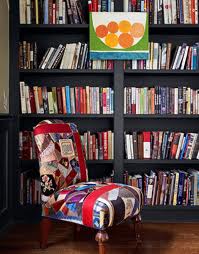
Back to our renovation/extension plans. One of the things the architect and I have talked about is a wall of books. This is to be along a walkway that is designed to link our old house to the new part of the house. I'm very excited and spend lots of times visualising it. I imagine the shelving to be a little like this.

As it is a walkway there won't be any room for chairs and tables. It is literally along the entire wall so you should be able to walk along it and peruse titles. Filling this bookshelf also has me daydreaming excitedly. At present my collection would probably only number a third of what this wall could contain, and I'm just quietly sitting back thinking of all the lovely stories I'm going to slowly fill it with. I don't plan to do it in one rush, but rather spend years adding to my collection.

Friday, April 22, 2011

A coffee a day keeps cranky mum at bay.........


I'm really into my coffee. I think I may have said this already a couple of times on this blog. I have one espresso a day - if I'm out it's a strong latte and if at home it's more of a macchiato. I'm so into my coffee that one year I even convinced myself that it was a good idea to buy a cafe. What a mistake that turned out to be. The cafe that is, not the coffee. That of course was the shit year.

I've been thinking about when I start teaching how am I going to get my espresso fix? This probably seems really inane but I get anxious about this. One of our lecturers was giving us some practical advice for when we go out into schools. She talked about putting money into the tearoom kitty. Not that I expected schools to have an espresso machine, but the thought of having to drink bad coffee everyday sends shudders down my spine. Or even worse, having to make use of the dreaded urn!

I have thought of a way around this dilemma. I have an old espresso machine - that makes a great coffee - that I can take with me to a school. It's portable enough. I think I will probably do just that when I actually start teaching at a permanent school. But, I'm a student teacher. This means I have to be ballsy enough to turn up to teaching rounds carrying my espresso machine with me (and all the accoutrements that go with of course). I think the other teachers will think I'm insane! As I'm studying part time I won't need to worry about this until next year when I actually do my teaching rounds - see I told you I get anxious about this and I'm already worrying. I'll let you know later down the track how the other teachers react to the appearance of my espresso machine. Because of course I will have to take it.

In the meantime I thought I'd share some places that I really enjoy a coffee at when I'm out and about. Not that that happens much nowadays with two very young children. I like to go to Boheme cafe on Bridge rd and another good one is Kojo Brown. Chimmy's bakery does a great one also. Some others I've discovered is Kanteen, Hektor Woodley's and when I'm in the city Journal and Degraves espresso bar.

Degraves espresso bar


Hektor Woodley's


Kanteen

Sunday, April 17, 2011

Time spent teaching is never lost


Considering the direction I am going I found this very inspiring.


I cannot imagine a day of my life without reading. This is why I studied literature in college. This is why I became a teacher: to share in grand conversations about books, to spread the joy, to initiate and welcome students into the fraternity, into what Frank Smith (1988) calls 'the club of clubs,' to travel with them into wondrously familiar or incredibly strange imaginative worlds.

Wilhelm, Jeffrey D. (1995). you gotta be the book: teaching engaged and reflective reading with adolescents, Teachers College Press, New York.

Saturday, April 09, 2011

Connecting with students in the classroom

I have to do a presentation in a few weeks about getting today's student to connect in the English classroom. One idea I want to explore is using adventure games as texts. I prefer to call adventure games interactive fiction. How may playing an adventure game help students learn or advance their literacy you may ask? Well I see it as a unique way of looking at narrative. Other ways for a story to be propelled. Exploring characters. Using the game as a visual to encourage descriptive writing. Perhaps students could also explore an ICT component and try creating their own games? Also some games are based on books so it's a good way to look at the story telling on another platform. A good example of this is Bladerunner. Here students could examine the book, movie and the game and compare the three. Probably the best way to use games as tools is for creative writing. The following are some screen shots from a few games, and I think they're a fantastic visual for students to propel their own writing.

Blackmirror two


Bladerunner


Secret Files Tunguska


Syberia


Syberia


To add more food for thought here is a youtube post that talks about using games in the classroom to inspire creative writing. Importantly watch the students faces as they interact with the game Myst. Now that's connecting in the classroom.
http://www.youtube.com/watch?v=YZrkzXOV15k

Friday, April 01, 2011

The Passage


The Passage by Justin Cronin, I would give four stars out of five. Great book, and I'm always one for a good horror tale. It lost one star, because when the second half of the book began and he introduced new characters I kept on forgetting who was who. They got a little lost in the storytelling. However towards the end things picked up well. Enjoyable.

Kitchen inspiration


Here are some Kitchen photos I'm gaining inspiration from.
I'm loving the charcoal cupboards, but I want mine to be more bluish rather than grey. I think stainless steel appliances look great against this colour combination.

We have a fireplace that faces out in both our existing front rooms. Since we're demolishing walls, we're keeping the fireplace column in the middle of the open plan. This means that our kitchen will have a fireplace facing in. I think this will automatically give the kitchen a bit of a French Provincial feel. I also love the idea of the light fitting being a rustic wrought iron lantern type thing.


As well as this I like the idea of having some open shelves somewhere.......

Kitchen colours and materials

As part of our renovation we've decided to go for a fairly monochrome colour scheme for our kitchen. The kitchen will be U shaped with a free standing stainless steel oven and stove and streamlined drawers and cabinetry on one side. On one wall is a large window and the sink and dishwasher will be there. I'm hoping to try and fit the fridge on this side too, but it will depend on the window size. On the right arm of the U shape is more windows and ample bench space.


This is the colour planned for the cabinetry.


For our benches we plan to use Caesar stone organic white


Splashback is marble


Finally the walls are to be half-strength Dulux Clotted cream

It's been a long long time - hinge post

Okay, so I'll be the first to admit that this blog hasn't seen the light of day on my computer screen for quite some time. I'm going to call this post a bit of a hinge. Allow me to explain. I've been reading some of my older posts and my life has changed so much since then. I started the blog when I began my degree to 'publish' my writing. I was also working in a university library at the time. Well when I finished my degree I was pregnant with my first child. I graduated in March 2007 and my son was born in April. How's that for timing!!!
As well as this my husband was offered a position in Queensland that we took, so I resigned from my library job and the three of us lived on the Gold Coast for two years.
We returned home to Melbourne in 2009, to the same house as we rented it out, and my daughter was born a few months later. So really when you think about it, I was pregnant with my son when we moved to Queensland and had him up there, and did the opposite later, where I was pregnant with my daughter and moved back to Melbourne and had her here.
So life has been a whirl of playgroups, library outings, park play, gymbaroo, music maestro, kinder and daycare.
After four years of children's activities I've decided this year to focus a little bit more on myself and I've started my Masters in secondary teaching. This also means that in two years time I should be able to re enter the workforce as a teacher. A prospect I find very appealing. My methods are English and Humanities.
The other big news is that in a few months time we will be starting a major renovation/extension. Presently we are oozing out of the cracks of our house, that was just fine when it was the two of us, but now with our added offspring. Well, the sooner we add on these rooms the better. As we plan to live here whilst the building is happening I'm sure will provide much fodder for this blog.

Sunday, November 01, 2009

Been a long long time

Been a long time and I now have two children both under the age of three. Must lose weight!!!

Friday, December 22, 2006

The countdown is on

Well I'll be moving to Queensland in January, and today is my last day at work. Christmas and New Year in Melbourne, lots of packing, and then moving North for the next few years.

I have mixed feelings about the move, so much so that I'm walking around saying, "it's only for a few years, it's only for a few years......" I'll be the mad woman walking around Queensland, pushing a pram (because I'm having a baby) with two dogs, repeating this mantra out loud to myself.

Friday, October 06, 2006

Fifteen commandments for mystery writer's who want to be published

Brought to you by You can write mystery.

I. Thou shalt think like a professional starting now.

II. Thou shalt begin and keep going till you're
through.
Writing is rewriting. Let that give you confidence as you stumble along - you can
make it better after you finish a draft.

III. Thou shalt take your efforts and desires seriously.

IV. Thou shalt call it work.

V. Thou shalt write for yourself, not the market.

VI. Thou shalt not wait for visits from the muse.

VII. Thou shalt not ask whether you are good enough.

VIII. Thou shalt not intimidate yourself by comparing
your writing with a published and polished work.

IX. Thou shalt not worry whether your idea is new
enough.

X. Thou shalt not talk your idea away.
The words on the page will allow the reader to live your story. If you tell it to
someone the xperience will be completely different and disappointing.
XI. Thou shalt not self-censor at all during the first
draft.

XII. Thou shalt not risk writer's paralysis by looking
for the precise word or being afraid of sounding
dumb.

XIII. Thou shalt not believe that if writing's hard, you must be no good.

XIV. Thou shalt not set yourself up for failure with
impossible goals.

XV. Thou shalt not believe in writer's block.

Friday, August 18, 2006

Back to the drawing board

It's all Agatha Christie's fault. The night before I began to read Dead Man's Folly. I'm only on chapter two and already I can see what's lacking in my own mystery novel. There are not enough suspects. I've been focussing so much on the actual villian that I've forgotten to introduce other possible villians and even to flesh out the other characters properly, aside from the heroine of course. What this means, is that I've had to work around the murdered character, and come up with possible murderers as well as motives etc. This has caused me to want to change some of the existing characters as well.

So, now I have to go and research once again. This time I'm researching characterisation. I did a little of this well before I started to write, but obviously not enough. I'm finding it difficult to strike a balance between the research aspect of writing and the actual writing. When do you know enough is enough? It looks as though I haven't done enough, otherwise I wouldn't need to go back to the drawing board so to speak to continue with the research.

So, this week I will continue with some research. I will decide who my cast of characters will be once and for all and what part exactly they play in my murder mystery.

Wednesday, August 09, 2006

Writing and the order of things

I'm trying to organise myself and the way I write. Over my mid-year break I found this to be a fairly easy thing to do, but with other classes and work, I'm finding it difficult to find time to write, yet alone strike a balance between my other subjects and work

Something I discovered only recently, is that I can write from my head into the computer. Everything I wrote prior, was in long hand. A subject I did last semester called Electronic Writing, forced me to think differently in relation to writing. At first I found this idea really going against the grain, but over the break, I tried writing my story straight into the computer. Admittedly, there were bits and pieces that I had written in my journal and in an excercise book, specifically bought for the writing of my detective mystery. I found that I suddenly had a freedom of writing, and that my typing could keep up with the sentences coming out of my head. I didn't do my typing lessons in school in vain! So, with this tool, if you like, harnessed, I found I was able to write, add the bits and pieces from my journal, change things around, and more importantly, delete. Deleting writing is the hardest thing to do.

As the title of this post is 'writing and the order of things', I thought I would list a bit of a to-do-list. I need to research more. Not just write. Therefore, I will begin researching the following:

  • Historical journals from Australia's Victorian past. Dates approximately 1850 onwards
  • Old architecture in Australian rural towns

As well as the research, I need to keep writing. Otherwise I feel like I will lose the impetus of the story. That brings me to ordering my day. How to work writing around my other academic projects - that seems completely frivolous in comparison. I've struck upon the idea of writing on Saturday afternoons/evenings/nights. Unless my social life intervenes. Although, it is semester time so the social events should really be curtailed. Anyway, this seems like a good time to at least aim for. Thus, this post has now allowed me to get some sort of order in my mind in relation to my writing.

Friday, July 28, 2006

Literature/Media Project

I have been asked to submit a Statement of Intention for this class this semester. The following is the statement:

HALM317 Literature/Media Project
Statement of Intention
I have been working on a detective mystery novel, off and on, for the past year. My Literature/Media Project will be continued writing of this novel, as well as conscientiously exploring the writing process. At present, the draft manuscript is close to 20’000 words, most of this writing taking place during the mid-year break 2006. My personal goal is to have the manuscript at least 50’000 words by the end of semester. I plan to use this project to structure my writing. I don’t expect my supervisor to read 50’000 words; therefore I will submit the following for assessment:
  • An outline of the plot
  • Profiles and brief biographies of the central characters
  • A bibliography and reference list of works consulted for the research of this novel
  • The first chapter as a final draft, or as near to it


My experience of this project will be documented on my weblog, http://scribeswindow.blogspot.com

My hope is that the above will give a good framework to continue the novel to completion.

Thursday, December 22, 2005

Holland's Social Experiment: following the Dutch drug debate.

Recently I was fortunate enough to visit The Netherlands. My two weeks there was during second semester at University, and whilst there I needed to find and write about a topic for a feature article for a journalism subject I was doing. This is my article.


Like an indulgent, eccentric uncle, Amsterdam is a European city, where people who want to legally smoke cannabis can do so openly in one of Holland’s coffeeshops, much to the concern of the city’s surrounding neighbours. These neighbouring countries take a harder stance against drugs that is at odds with Holland’s social experiment, where the Dutch believe their lax attitude is more compassionate and a better way.
One of the first places many of Holland’s tourists visit is Amsterdam’s coffeeshops. Located along the city’s canals and narrow streets, they display a green and white sticker on their windows, indicating that inside you will find a hash or weed menu. However, you don’t really need to see these stickers to know that you can get high within Amsterdam’s coffeeshops, as the sweet, pungent aroma emitted from them is clue enough. Glancing through one of the hash menus, I found offerings such as “Hawaiian Haze”, “Juicy Fruit”, and “Purple Power”. There are pre-rolled joints, weed from Morocco, indoor plants, outdoor plants and marijuana dubbed either local or foreign.
According to a display at the Amsterdam History Museum (Historisch Museum), the Netherlands have decriminalised soft drugs since 1976. This means that in Holland a blind eye is turned to the sale and use of up to five grams of marijuana.
The display also includes a video, where an American accented panel of experts debate the merits of Holland’s drug policy, the amended Opium Act of 1976.
Pietr, who works at the History Museum thinks that the Dutch government is becoming increasingly conservative. “All the time medical reports are coming, saying that the use of cannabis is not good. Personally I do not like the smell. I hate the smell of smoking. It is everywhere. I do not like it”.
The smoky marijuana smell is indeed everywhere. This is particularly noticeable when zigzagging through pedestrians and the throng visiting coffeeshops, trying to locate the Hash Marijuana Hemp Museum, finally finding a doorway flanked by Marijuana plants and that distinctive odour. The man accepting Euros for entry into the museum was extremely cagey in answering any questions. Standing beside him was a belligerent American woman, puffing a joint, the marijuana smell emitted from the museum clearly coming from her. Declining even first name basis to be used, the man behind the counter kept trying to usher me towards the disorganised displays in an effort to answer my questions. The man at one point became irritated at my use of the word “legalised”. With a shake of his head and a deep frown, he emphasised that marijuana use is “tolerated” not legalised. From then on, in all my conversations regarding soft drug use, I made sure I used the word, tolerated instead. He told me that households are allowed five plants, and there is continual pressure from the United Nations to stop it. “We do not drink alcohol. We smoke”. With a shrug he continued, “Smoking can be bad for you. You can get addicted. It’s never written down when somebody dies using it”. Then, giving me his one and only smile, “if politicians were to smoke it, there would be less problems”.
Most of the Hemp Museum’s displays were propagandist. Lots of yellow and brown cutout newspaper articles taped along the walls, citing headlines of human rights and the drug war. There was a display about Pot Pride Marches that also included a poster of a marching chant: “We’re here, we’re high. Get used to it”.
A few doors down, at the Tiani Hemp shop, I spoke to Jorge, who was much more forthcoming than the man at the Hemp Museum. Jorge has owned his hemp shop for thirty years or more, selling all the hemp products associated with the drug, but not the drug itself. “The hemp is used for a lot”, he told me, “plastic, material, shirts, soap, rope, everything”. He nods in satisfaction. “The tobacco and plastic companies stopped production of hemp because of plastic competition”.
Jorge also thought that becoming addicted was not true. “I have smoked for thirty years. If you want to believe them…. I believe myself. Smoking has been happening for thousands of years. There’s Indian culture, Arabic, Latino, Indigenous. I think of it as a cure. People who have asthma; it opens their lungs”. Jorge is often asked for the drug itself, many tourists coming to the shop thinking they can get it here. He directs them to the numerous coffeeshops surrounding his establishment.
According to the Dutch Justice Ministry, coffeeshops numbered 1’179 in 1997, and this has dropped to 754 in 2003. Jorge is concerned about this. “Since the sixties people are making a living from this. Making money. They grow it in their own homes. Some people grow in special places, but the police catch them, so they have to grow in their homes. It’s a family affair”. Jorge explains to me that the government will not renew or issue new licences. Consequently there is no new coffeeshops opening. However, more hemp shops, like Jorge’s, are started. “If the owner dies they won’t renew. This is how they stop it. Coffeeshops are fighting this by becoming an association or cooperative”. Then he adds, “Politicians like to keep quiet because it brings tourists to Holland. Hotels are full. Everybody that is here is happy. Other countries have a higher percentage of violence. In England they drink alcohol, they become aggressive, they fight. Here they smoke; they want to make love. Other countries drug addicted people die on the street. Here people have somewhere to go”.
There is certainly an argument here. The Dutch have always reasoned that the coffeeshops allow their authorities to keep a close eye on cannabis use. Their policy also includes low threshold treatment. This means that those with a drug problem are encouraged to seek help, and Holland’s drug programs are designed so minimal paperwork is involved and minimal demands are made. The Centre for Drug Research, University of Amsterdam (CEDRO) contends that cannabis use is substantially lower than often assumed. An article from the Journal of Health and Social Policy, debates the Dutch drug policy and asks if it can be used as a model for America. The Netherlands and the USA being two countries at distinct opposite sides when it comes to drug use. The Netherlands support ‘harm reduction’ whilst America prefers ‘supply reduction’. The latter policy promotes reducing drugs, and enforces strict sanctions on those who do not. To the consternation of many of Holland’s critics, drug use has had a negligibly small increase since 1976. In other parts of Europe and also America, there has been much increase, despite prohibition.
Jorge also enthusiastically tells me about the Cannabis Cup. The Cannabis Cup has been awarded for the last sixteen years to someone or a company providing excellence in marijuana samples. When the Cannabis Cup event is taking place, there are many tours frequenting the coffeeshops. An event some tourists may not want to miss.
Most Dutch people seem to advocate Holland’s ‘social experiment’. Further afield, in the small town of Emmen, about three hours journey from Amsterdam, I meet the Boer family. Invited for a traditional meal, I enter their awe-inspiring home – a completely renovated Dutch farmhouse, hundreds of years old, but brought into the twenty-first century. The Boer family have converted the farmhouse into liveable conditions, but it still has its imposing thatched roof, and inside, the black misshapen beams with their patina of age. Even here, miles away from Amsterdam’s coffeeshops, this topic created much debate from nine people seated around the dinner table.
Marius Boer, the eldest son in his twenties says, “it’s a good thing, and it keeps away criminal things. When it is allowed it is controllable. To go under, it will not be. Trading is done at a reasonable level, the legal price goes down. What’s the difference between alcohol and hemp? It’s a soft drug”.
Marius’ parents, Peter and Karen Boer agree, Karen saying, “It must be free and allowed. Whatever you want. Also the hard drugs. Problem is solved, the price drops to nothing”.
Peter talks about the production of marijuana. “A lot of energy is put into the growing. A lot of countries are looking at how Holland controls its drugs. You can buy equipment for three or four thousand Euros, and make it back in a year growing”.
“Less than a year”, Marius interjects. Everyone around the table nods.
Peter continues. “A room, lamps, ventilation. Power companies can see power being used in the meters, they can come and close you down”. The Boer family tell of one of their neighbours close by. His thatched roof had no snow on it! His home had big gates and also big dogs! Everyone laughs at the visual of a house with no snow on its roof, due to the heat inside, growing marijuana plants.
Robert, another guest says, “We should tolerate it. But I’ve never tried it”. I turn to him surprised. Robert who has lived in Holland all his life had never tried marijuana? Is this unusual, I ask? He shrugs in answer. Peter answers for him, “When it’s not seen under the table you can control it. That’s the tactics here. Holland is united thinking the same thing. When people deal in the street it is frowned upon. Why sell drugs on the street if you can get it in the shops?” He looks at Robert, “because it’s not experimental anymore”.
I ask Karen and Natasha, another guest, how they feel about children and marijuana. Karen responds first, “I hate it”. Henk, Natasha’s husband tells me, “I hope not, that they will use drugs”. Natasha says, “I am afraid of it, that they will use drugs”. At this point I see natural parental concern. Even though Holland’s society is tolerant about drugs, there is still an instinctive worry about their children.
Jacqueline, Marius’ girlfriend gives her opinion here. “I think it has to do with your social life and your friends. When I was in school I wasn’t in a group that experimented with drugs. The friends I had were very close, from the age of four. We were always the same group doing other things”.
Karen tells us, “At school, policemen stand there during breaks so that dealers don’t come”. Everyone frowns at the thought of drug dealers in the street.
There is a powerful argument of economics that Peter contends, “coffeeshops are closing. Nobody is interested anymore. When there is too much supply the price drops. There will be a peak for a short while. There were three or four coffeeshops in Emmen, but now two are closing because there is no interest anymore”.
Back in Amsterdam, walking the city’s streets, I see people milling about a doorway. Realising they are just watching table dancers I continue on my way, the hoots of jocularity fading as I go. Later I see a bicycle tour. A group of girls are about to embark, donned with party hats and pretty clothes, here for a hen’s weekend, the bride-to-be’s last hoorah. I pass wild bucks parties, groups of people from all cultures, roaming the streets, some clearly worse for wear, away from the usual humdrum of their working lives. I think of Jorge’s words: the tourists come; the hotels are full. Everyone is here in this all-encompassing party city, which Amsterdam is known for.

Tuesday, December 13, 2005

What I've been reading lately: If on a Winter's Night a Traveller (a postmodern essay.)


To open a book is to invite the fictional world in. Readers always know when they are reading fiction. There are conventions and codes, an author to listen to, reading is a way to understand and think. The most challenging feature of postmodern writing is its insinuation of the fictionality of the world we live in. Readers are challenged when overt metafictional writers, such as Italo Calvino, choose to display the fictionality of their novels. This essay will focus on Italo Calvino’s novel, If on a winter’s night a traveller. It will explore metafiction, a type of postmodern writing and examine the conventions of fiction, deconstruction of language, the notion of an author and their precursors and the relationship between reading and writing. All this will reveal the fictionality within postmodern writing.

Italo Calvino is deliberate and determined to convey the notions and the intricacy in preparing a text. It is never forgotten that we are reading a book. There is an author, a scene set, a plot and characters to be met. Calvino intentionally allows the book’s contrivance to be seen. He asserts this from the very beginning in his opening chapter: “You are about to begin reading Italo Calvino’s new novel” (Calvino, 1998, p.3), and later: “The novel begins in a railway station, a locomotive huffs, steam from a piston covers the opening of the chapter, a cloud of smoke hides part of the first paragraph” (Calvino,1998, p.10).

Although we are reading, we are never directly able to read for ourselves, someone else reads each narrative and this allows Calvino to highlight the novel’s constructs and conventions. “We are never allowed even the illusion of direct access to these stories: they are all mediated, which is just another way of saying that they are fabricated” (Brink, 1998, p.317). Through the eyes of others such as, the narrator; professor Uzzi-Tuzzi; Lotaria and Silas Flannery, we are made aware that this is a book and it has been made. Furthermore, we are told that even these readings have been read before, translated by the infamous Ermes Marana. The novel has been previously read, previously interpreted and constantly mediated.
Jacques Derrida, a postmodern theorist, examined the use of language. He saw language as deconstructed, disorderly and unstable. Language viewed this way allows for interpretation. Disorderly and unstable means that when language is used to represent, to each person that language can be different, therefore destabilised and unstructured. An author may have the best intentions to use language to represent one particular view, but this may not always be the case. Calvino emphasises this further in his novel.

“[The] act of reading…becomes simultaneously an act of radical destabilisation of language. Each of the readers in Calvino's novel reads the ‘same’ novel, yet experiences it as a ‘different’ novel; the whole process of reading unsettles fixed meanings” (Brink, 1998, p.314).

Derrida also used the theatre as an analogy to writing, to convey this idea.
“[An] author-creator who, absent and from afar, is armed with a text and keeps watch over, assembles, regulates the time or meaning of representation…He lets representation represent him through representatives, directors or actor, enslaved interpreters who…more or less directly represent the thought of the ‘creator’” (Ritzer, 2003, p. 584).

Similarly in fiction, language represents the thoughts of the creator and the reader is the interpreter. This is an important concept in postmodern writing. Also is the notion of previously read, previously interpreted, mediated, represented and then interpreted again and again. It is the idea of precursors. An author has read before. An author allows these ideas to influence their writing. The ideas are consequently mediated or represented and the reader, in turn, re-interprets these ideas. If the reader is also a writer, the cycle continues.
Calvino's If on a winter’s night a traveller uses the premise of precursors and portrays it through his novel by different chapters. The “novel offers an increasingly, dizzying experience of reading, with each chapter acting as supplement to what has gone before and as a preface to the next” (Brink, 1998 p. 320). Precursors are important to the idea of the author when it is explored. It questions the notion of ideas mediated, authors influenced, akin to Derrida’s notion of representation.

Calvino uses his character Marana to display this, where he deems authors irrelevant. (Calvino, 1998, p. 101) As if to say it is everyone’s and anyone’s idea.
“Marana often misrepresents what he sends to publishers, submitting manuscripts incorrectly titled and attributed and sometimes passing off insignificant works as major works. Marana is a kind of anti-authorial terrorist" (Gaggi, 1997, pp 56-57).

Michel Foucault examined the idea of author-function. Foucault, another postmodern theorist, looked at the way writers would seek to write what they believed to be an individual voice. However, Foucault asserts that the reading of any given text allows for inevitable interpretation. Multiple readings, changing an individual voice into a fractured voice:
“that the author-function is a construction that imposes ideological constraints upon the reading of a body of texts identified as being by a certain ‘author’…the subject of the author in particular – is a product of discourse rather than the origin of discourse” (Gaggi, 1997, p. 57).

A good illustration of this is Calvino’s idea of two writers, each struggling to write, and while imagining the other writes better, each begins to write as they imagine the other would, and consequently they write the same book.
Calvino goes on to include computers in his novel that are working to emulate the work of famous writers. Here he is “demystifying literature and the author” (Gaggi, 1997, p. 62). Calvino’s novel shows that an author's own discourse is a product and cannot be described as original, he shows it to be ‘fictional’.
Calvino allows the authorship of his own novel to be ambiguous. Calvino himself, a real author, allows himself to be a character. This questions the idea of what has been written and by whom? Marana’s deliberate attempt’s to steal, forge and misrepresent texts ensures that “reading will be freed from the constraints imposed on it by the aura of authorship” (Gaggi, 1997, p. 57). Roland Barths, also a postmodernist, asserts that in writing there is the ‘death of the author’. “The more the author appears, the less he or she exists. The more the author flaunts his or her presence in the novel, the more noticeable is his or her absence outside it” (Waugh, 1984, p. 134). Certainly Calvino is doing just this in his novel, and by doing so he is breaking the conventions of fiction writing.

“I have – no, the author has – been circling around the feminine presence, for several pages you have been expecting this female shadow to take shape the way female shadows take shape on the written page, and it is your expectation, reader, that drives the author towards her” (Calvino, 1998, p. 20).

If on a winter’s night a traveller is metafiction. Fiction about fiction, stories within stories. Linda Hutcheon writes about metafiction and she calls this narcissistic text. She talks about reading narrative and expectations a reader has. When these expectations are not met, she says writers know full well that they are overtly being self-conscious in their writing and the subverting and breaking of novelistic codes show this. (Hutcheon, 1984, p. 139) Thus far, Calvino has unsettled the author, the novel’s conventions and used the notion of precursors and this easily falls into Hutcheon’s theory of narcissistic text.

The book does not conform to a linear fashion. Instead Calvino allows it to be multi-linear. One story or chapter can lead to the next, but it can also lead to others, all at the same time and even re-trace itself back. An example of this is when the book’s narrator goes in search of the famous author Silas Flannery. Flannery describes his ideal reader, clearly evoking the character of Ludmilla. This image of Ludmilla connects her to the reading of all the previous chapters as well as future one’s and also within Flannery’s own writing. Indeed, Ludmilla’s character is a good example of portraying the novel as being multi-diagetic, where “stories successfully frame other stories often to the point of infinite regress (Cotrupi, 1991, p. 2 of 7)

As well as being multi-diagetic it has been argued that Ludmilla personifies the male reader’s erotic desire. There are three quests running alongside each other. The quest for Ludmilla; the quest for the desired perfect reading experience and the narrator’s quest to find his elusive narrative. Reading is spurred on by the desire to see what comes next. Ludmilla’s character is a metaphor for sexual conquest. (Cotrupi, 1991)
Calvino elaborates on the different types of readers. Ludmilla and Lotaria are contrasted.
“Ludmilla, the named and described female reader, clearly personifies the ideal reader in pointed contrast to Lotaria’s pseudoscientific, ideologically motivated, devalued, and degenerated readings of the texts” (Cotrupi, 1991, p. 3 of 7).
Further, Ludmilla talks of there being a boundary line for the reader when she refuses to accompany the narrator to the publishers. Ludmilla prefers to be just a reader on a quest within the fictional world only.
“There’s a boundary line: on one side are those who make books, on the other those who read them, so I take care always to remain on my side of the line. Otherwise, the unsullied pleasure of reading ends, or at least is transformed into something else, which is not what I want (Calvino, 1998, p. 93).

Calvino’s manipulation lays bare all the literal conventions of the novel and reveals its interior constructs, and also its exterior constructs. Many protagonists in the novel belong to the literary world, the realm of books. The writer; the reader; the publisher; the narrator; the bookshop owner; literary agents; the academic; the librarian; the plagiarist and the translator. He has incorporated all these into his storytelling. Writing fiction and the ‘real’ players all at once.

“Through these innovations Calvino has added another layer to the semantic density of fiction, incorporating within the narrative text not only an awareness of its own status as literary artefact or verbal construct but also an explicit self-engagement with its role as literary text, as the locus of human creative, perceptual and hermeneutic activities” (Cotrupi, 1991, p. 2 of 7)

Calvino exposing literary construction allows the book to be an overt metafictional novel, a narcissistic text. Calvino subverts the notion of the author, and deems them irrelevant. Where writers can write the exact same thing, but readers can read the exact same thing differently. For Calvino’s metafictional novel to succeed, he must alleviate the void between the fiction of the book and the real world. The reader must never forget that they are reading a book. Calvino does this by the ever-present reader reading over the shoulder of another. When a novel is opened and narrative begins, readers have expectations, but postmodern writing challenges this. Italo Calvino has succeeded in insinuating fictionality into his writing.

Monday, December 05, 2005

Feedback on my feature article

I'm very excited!! I received an email from my lecturer for my journalism subject. This semester one of my assignments was to write a feature article, and because I was fortunate enough to accompany my husband to Holland I decided to write about the drug debate.

Her email reads: If you are receiving this email it means you wrote a fantastic feature article. In some cases I have made recommendations for you to publish in a different magazine/newspaper in my comments, but your article would certainly be of interest to Tabula Rasa [student magazine] as well.

When I read this I felt that warm fuzzy glow, the kind when you have succeeded in doing something well. Note she used the word "fantastic"!! I do plan to post the article in the coming weeks. There's nothing like the feeling of getting positive feedback from someone. It really does make all the difference.
Related Posts Plugin for WordPress, Blogger...